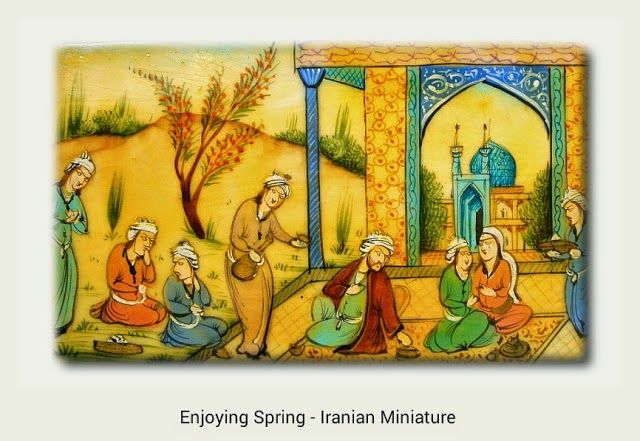
A Long Read 📖: On the thirteenth day, or Sizdehbedar, we venture out of the security of our home and government, and face the biggest question that can create the greatest havoc in our life – namely love and relationships.
Sizdehbedar سیزده بدر is on the first days of April, when it will be the thirteenth day of the Iranian new year. Most modern Iranians, do not know this, but ancient Iranians celebrated the first twelve days, and the thirteenth day was a very special day.
Most Iranians, think that the thirteenth day, is related to the unlucky number thirteen. That is not the case. In numerology, which assigns values to numbers, thirteen is actually four. Four is related to family, and funnily enough Iranians have the largest family picnic in the world.
The ancient Iranian calendar, respects the natural order of the universe. The cosmology of Iran is based on twelve constellations and other deities. So what happens on the thirteenth day?
The Iranian Creation Myth is a long story, but it is interesting and quite logical.
Iranians belief system, is based on the humans having a productive purpose. It is based on the concept of dualism.
Amesha Sepanta, is the equivalent of First Law of Thermodynamics. Energy can neither be created or destroyed. Haftseen is a reflection of that. It means seven S’s. The four elements and three life forms make the seven Amesha Sepantas.
Things existed or changed. There was choice and contentment, for all forms of existence. Humans had free will, to choose between choice and contentment. The ancient texts refer to these polar opposites, as Ohrmazd and Ahriman. The energy that was created between them was called Ahuramazda. The not so ancient texts, speak of a war between good and evil. These are exaggerations, created by belief systems that did not have free will. These younger religions believed in holy places.
The Zend-Avesta explicitly forbids holy places. The original texts, speak of a world without order. Humans were placed to a civilize the planet, with free will, within the confines of the twelve constellations’ energies. The thirteen day, refers to the moment after the twelve energies. They are even encouraged to lie on that day. April’s fool comes from that.
So in Sizdehbedar, the Iranians go into the wild, and have a picnic where there is no order. It is custom for the King of Iran, to also come into the midst, and be on equal footing with the people. It goes back to the moment, when there was no civilization.
The Earth was the place, that we had to all enjoy, throughout the year. This is were The Good Deeds are carried out. So the first twelve days, were each respected for the twelve constellations, that form the twelve solar months of the Iranian calendar, invented by the Good Mind, to create the first civilization on Earth.
After the twelfth day, or on the thirteenth day, we close that chapter of celebrations. We begin the rest of the year. It was such an end of celebrations, that all Iranians and the government, rejoiced in nature by having a massive reunion in nature.
The only way Iranians can keep in touch with their very ancient natural roots, is to have a full day in nature and make our dearest wishes. In nature we have the polar opposite of human civilization we created for the first time. Only when we began to measure the seasons and time, did we humans create order and civilization, for the first time ever in the Iranian plateau, out of natural chaos.
Embracing this chaos is what Sizdehbedar is all about. This view is rarely mentioned.
Let me start with this real present day comical story:
A conversation took place, when the first Iranians arrived in US in 1979, after the Shi’ite uprising. The story goes that the police in LA summoned the Iranians, and asked them for questioning on the fourteenth day.
The Chief of Police said, “We have never seen, thousands upon thousands of people, gather in the parks so peacefully. We did not make one arrest”.
So the Iranian organisers said, “Heck, you have asked us to come here, scared us out of our wits, for this?”.
The Chief of Police said, “No, but there is one very important question, that is bothering us”.
The Iranians raised their eyebrows, and held their breath. “Khoda in chi mikhad bege? Or OMG what’s he gonna say now?”.
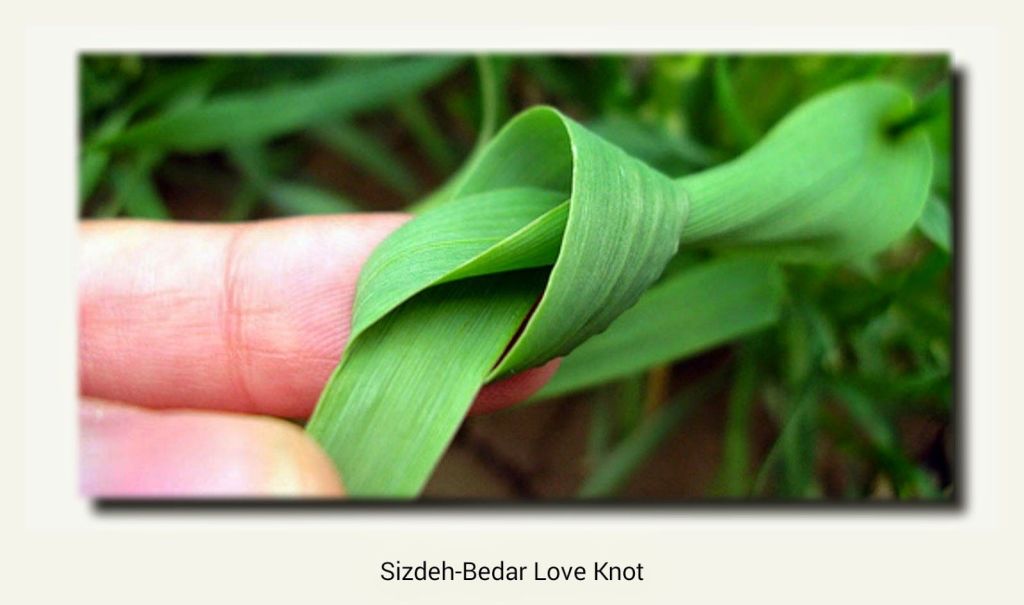
The Chief of Police said, ” Yeah, so what we’re curious about was, why is it, that all the grass was knotted?”. At that point the Iranians all laughed in relief.
On the thirteenth day, or Sizdehbedar, is to venture out of the security of our home and government, and face the biggest question that can create the greatest havoc in our life – namely love and relationships. Iranians found their new home outside Iran and were accepted. All the single people make a wish for a happy marriage, by finding the two perfect reeds of grass and tie a perfect knot. Love is in the air. All strangers see our culture and respect it.
For so long, this was the natural force that bonded Iranians in Iran, and defeated the invaders, by showing the massive unity, carrying out a harmless celebration. It introduced us in the foreign lands peacefully. Our youth were not seen as rebelious against our enemies, or when we were refugees in foreign lands. We have a unity based on love of nature, that permeates in our own society. It was not political or religious. It is just Iranian.