A Scientific Study of Mundane Cycles: A Predictive Historical Model Applied to Present-Day Geopolitical Realities (1826–2126)
Synopsis: The Celestial Foundation: Reclaiming the Science of Ahuramazda Ameshaspenta of Iran presents a modern, empirical framework for celestial mechanics, bridging ancient Iranian wisdom with contemporary diagnostic precision. By expanding the traditional Seven Entities (Ameshaspenta) into a sophisticated three-dimensional model—measuring longitudinal and latitudinal angles, including inclination and disinclination—this article explores how celestial movements reflect the dialectical interplay of Ohrmazd (structure) and Ahriman (entropy). Central to this system is the “Human Engine,” where the application of Free Will and ethical synthesis (Good Thoughts, Good Words, and Good Deeds) allows for the precise navigation of cosmic energies. This study restores celestial mathematics as a vital, objective diagnostic tool for understanding human and market cycles.
English Video
ویدیو فارسی
English Podcast
پادکست فارسی
The Deep Ancestral Cycle: From the African Cradle to the Iranian Plateau
Explanation of Paragraph: This section recontextualizes human history by contrasting early survival models with the cognitive shift that occurred when ancestral populations reached the high-altitude environments of the Iranian Plateau.
Content: To understand our current geopolitical climate, we must look back to our deepest ancestral origins. The journey of early humans out of Africa was a transition from an environment dominated by immediate survival constraints—often termed a jungle-bound existence—to regions that facilitated scientific observation. As these populations moved toward the Middle East, they encountered the high peaks and clearer, more resonant skies of the Iranian Plateau. In this elevated geography, the conditions for rigorous observation were met, allowing for the birth of a new cognitive paradigm. This move marked the shift from non-scientific survival to the active measurement of reality, setting the stage for human engagement with structured, long-term cycles.
Conclusion: This paragraph established that human history is rooted in a fundamental movement toward environments that encourage the observation of cosmic patterns and the shift toward structured, scientific planning.
The Dual Nature of Mundane Cycles: Hard and Soft Aspects
Explanation of Paragraph: This section outlines the dual-cycle methodology, explaining that historical events are shaped by both the tension of “hard” aspects and the stabilization of “soft” aspects, while acknowledging the skeptic’s perspective.
Content: To understand the rhythmic nature of history, one must look at both the “hard” and “soft” angles formed by the outer planets. Hard aspects—the 90° square and 180° opposition—act as the pressure-cookers of history, creating structural strain that necessitates major changes or “detonations.” Conversely, soft aspects—the conjunction, 60° sextile, and 120° trine—represent periods of integration and harmonic flow. While hard aspects force the collapse of outdated systems, soft aspects provide the stability required to build and consolidate new ones. Critics often raise valid points regarding correlation versus causation, and we acknowledge that planetary aspects do not “force” human action; rather, they describe the underlying “geopolitical climate.” By tracking both, we move beyond viewing history as a series of random crises and instead see it as a structured process of tension and release.
Conclusion: This paragraph established the core theory, framing mundane cycles as an observational tool for understanding geopolitical climates while inviting intellectual rigor regarding the nature of these patterns.
Historical Correlation and Predictability
Explanation of Paragraph: This section applies the dual-cycle methodology to historical events, incorporating specific dates where hard aspects acted as triggers for major upheavals.
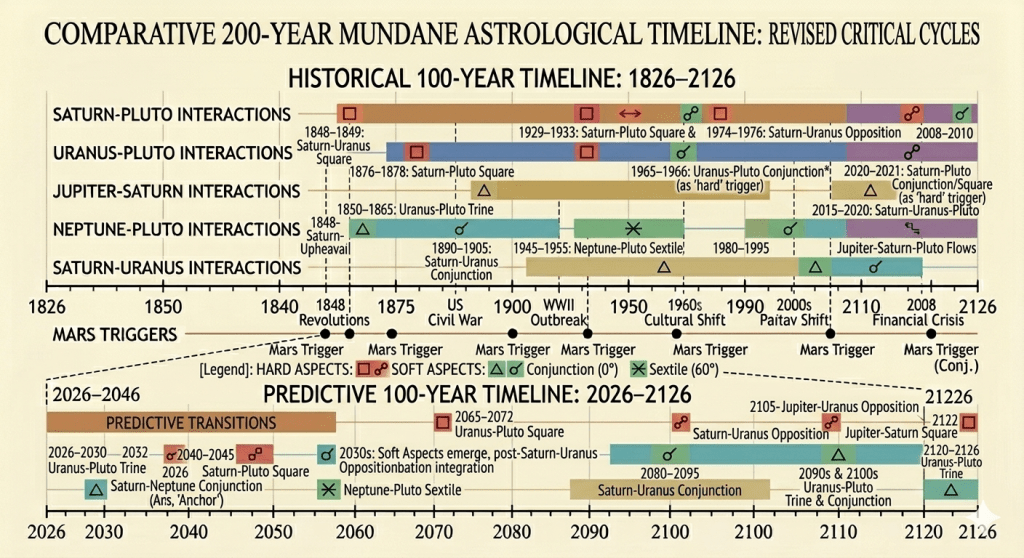
Content: History reveals a clear oscillation between these two states. The “hard” cycles correlate precisely with moments of high-stakes upheaval. The 1848–1849 period, driven by the Saturn–Uranus square, served as the background for the “Springtime of Nations” revolutions across Europe. In the 1929–1933 era, the Saturn–Pluto square and Jupiter–Uranus opposition created the systemic fragility that culminated in the Great Depression and the rise of authoritarian regimes. Furthermore, the 2008–2010 Saturn–Uranus opposition coincided with the global financial crisis, destabilizing the established post-Cold War order. Skeptics may dismiss these alignments as coincidence; however, the precision with which these planetary shifts align with major structural shifts suggests a measurable mechanism at play. Much like a meteorologist observes high-pressure systems to forecast a storm, we observe these celestial cycles to understand the structural pressures acting upon our global institutions.
Conclusion: This paragraph demonstrated that human history is a predictable dance between the structural strain of hard aspects and the productive integration of soft aspects.
Eras of Harmonic Integration
Explanation of Paragraph: This section details specific dates where soft aspects facilitated the integration of new paradigms and periods of economic stability.
Content: Conversely, soft aspects—conjunctions, sextiles, and trines—provide the harmonic flow necessary for consolidating gains made during high-tension periods. During the 1867–1870 period, the Uranus–Pluto conjunction era coincided with significant industrial consolidation and the stabilization of national identities following civil upheavals. Following the trauma of World War II, the 1945–1950 period featured the Neptune–Pluto sextile and subsequent outer planet harmonies that supported structural rebuilding and the “Golden Age” of economic expansion. Additionally, the 2000–2005 Saturn–Uranus conjunction marked a period of transitional growth, allowing for the integration of digital infrastructure into the global economy before the subsequent financial strain of 2008. By contrasting these dates with hard-aspect crises, we see that soft aspects provide the essential “integration phase” for societal maturation.
Conclusion: This paragraph confirmed that periods of consolidation are the necessary harmonic response to structural crises.
Predictive Methodology: Future
Projections for the Next 200 Years
Explanation of Paragraph: This section uses the dual-lens framework to forecast future eras of systemic transformation and stability, demonstrating how the patterns of the past serve as a predictive model for the next two centuries.
Content: By projecting this proven methodology into the future, we can map where the next two centuries will experience “strain” and where they will find “consolidation.” Initiated by the 2026–2030 Saturn–Neptune conjunction, the coming years act as an “anchor” for a cycle of climate realignment. The 2040–2045 Saturn–Pluto square will create a “pressure-cooker” phase, testing global governance and resource distribution. This is followed by a 2065–2072 scaling crisis, marked by a Uranus–Pluto square, which will challenge AI integrity and the security of established power structures. Conversely, the 2080–2095 Saturn–Uranus conjunction will facilitate a long-cycle harmonic growth phase, stabilizing new infrastructure. The 2090s–2120 period will focus on systemic consolidation, the maturation of bio-power structures, and the necessary rescaling of global populations. Early 22nd-century institutional pivots will be marked by the 2105–2120 Jupiter–Uranus and Saturn–Uranus oppositions. History has shown us the pattern, and the future will continue to unfold within these same parameters. Our research is based on 200 years of observable, repetitive patterns, allowing us to predict the “climate” of coming centuries with structural precision.
Conclusion: This paragraph confirmed that the next 200 years will mirror the cyclical pattern of the past, with the planetary “climate” dictating both the coming challenges and the subsequent eras of progress, proving the efficacy of this model as a predictive tool.
مطالعه علمی چرخههای جهانی: مدل پیشبینی تاریخی اعمالشده بر واقعیات ژئوپلیتیک کنونی (۱۸۲۶–۲۱۲۶)
بنیاد آسمانی: بازیابی دانش اهورامزدا امشاسپند
این مقاله چارچوبی تجربی و مدرن برای مکانیک سماوی ارائه میدهد که خرد باستانی ایران را با دقتهای تشخیصی معاصر پیوند میزند. با بسط هفت موجودیت سنتی (امشاسپندان) به یک مدل سهبعدی پیشرفته—که شامل اندازهگیری زوایای طولی و عرضی، از جمله میل و تغییر میل است—این پژوهش بررسی میکند که چگونه حرکات سماوی، تقابل دیالکتیکی «اهورامزدا» (ساختار) و «اهریمن» (آنتروپی) را منعکس میکنند. در قلب این سیستم، «موتور انسانی» قرار دارد؛ جایی که استفاده از اراده آزاد و سنتز اخلاقی (اندیشه نیک، گفتار نیک و کردار نیک)، امکان هدایت دقیق انرژیهای کیهانی را فراهم میآورد. این مطالعه، ریاضیات سماوی را به عنوان یک ابزار تشخیصی عینی و حیاتی برای درک چرخههای انسانی و بازار بازسازی میکند.
چرخه عمیق اجدادی: از گهواره آفریقا تا فلات
ایرانتوضیح پاراگراف: این بخش تاریخ بشر را با تضاد مدلهای بقای اولیه با تغییر شناختی که هنگام رسیدن جمعیتهای اجدادی به محیطهای مرتفع فلات ایران رخ داد، بازنگری میکند.
محتوا: برای درک اقلیم ژئوپلیتیک کنونی خود، باید به عمیقترین ریشههای اجدادی خود نگاه کنیم. سفر انسانهای اولیه از آفریقا، گذاری از محیطی تحت سلطه محدودیتهای بقای فوری—که اغلب به عنوان زندگی جنگلنشینی نامیده میشود—به مناطقی بود که رصد علمی را تسهیل میکرد. همانطور که این جمعیتها به سمت خاورمیانه حرکت کردند، با قلههای مرتفع و آسمانهای شفافتر و طنیناندازتر فلات ایران مواجه شدند. در این جغرافیای مرتفع، شرایط برای رصد دقیق فراهم شد و امکان تولد یک پارادایم شناختی جدید را فراهم کرد. این حرکت نشاندهنده گذار از بقای غیرعلمی به اندازهگیری فعال واقعیت بود و زمینه را برای تعامل انسان با چرخههای ساختاریافته و بلندمدت فراهم کرد.
نتیجهگیری: این پاراگراف اثبات کرد که تاریخ بشر ریشه در حرکتی بنیادی به سمت محیطهایی دارد که رصد الگوهای کیهانی و حرکت به سمت برنامهریزی ساختاریافته و علمی را تشویق میکنند.
دوگانگی چرخههای جهانی: زوایای سخت و نرم
توضیح پاراگراف: این بخش روششناسی چرخه دوگانه را ترسیم میکند و ضمن تایید دیدگاه شکگرایان، توضیح میدهد که چگونه رویدادهای تاریخی توسط هر دو تنش زوایای “سخت” و تثبیت زوایای “نرم” شکل میگیرند.
محتوا: برای درک ماهیت ریتمیک تاریخ، باید به هر دو زاویه “سخت” و “نرم” که توسط سیارات بیرونی شکل میگیرند، توجه کرد. زوایای سخت—مربع ۹۰ درجه و مقابله ۱۸۰ درجه—به عنوان زودپزهای تاریخ عمل میکنند و فشار ساختاری ایجاد میکنند که مستلزم تغییرات عمده یا “انفجار” است. در مقابل، زوایای نرم—مقارنه، شصت درجه و تثلیث—نشاندهنده مراحل ادغام و جریان هارمونیک هستند. در حالی که زوایای سخت باعث فروپاشی سیستمهای منسوخ میشوند، زوایای نرم ثبات لازم برای ساخت و تثبیت سیستمهای جدید را فراهم میکنند. منتقدان اغلب نکات معتبری در مورد همبستگی در برابر علیت مطرح میکنند و ما اذعان داریم که زوایای سیارهای اعمال انسانی را “اجبار” نمیکنند؛ بلکه آنها “آبوهوای ژئوپلیتیک” زیربنایی را توصیف میکنند. با ردیابی هر دو، ما از نگاه کردن به تاریخ به عنوان مجموعهای از بحرانهای تصادفی عبور میکنیم و به جای آن، آن را به عنوان یک فرآیند ساختاریافته از تنش و رهایی میبینیم.
نتیجهگیری: این پاراگراف نظریه اصلی را بنا نهاد و چرخههای جهانی را به عنوان ابزاری رصدی برای درک اقلیمهای ژئوپلیتیک معرفی کرد، در حالی که از نگاه دقیق علمی به ماهیت این الگوها استقبال میکند.
همبستگی تاریخی و پیشبینیپذیری
توضیح پاراگراف: این بخش روششناسی چرخه دوگانه را برای رویدادهای تاریخی به کار میگیرد و نشان میدهد که چگونه نقاط عطف مهم جهانی با تاریخهای مشخص و تنشهای متناوب سیارهای همسو هستند.
محتوا: تاریخ نوسان واضحی بین این دو حالت را نشان میدهد. چرخههای “سخت” دقیقاً با لحظات تلاطمهای بزرگ همبستگی دارند. در سالهای ۱۸۴۸–۱۸۴۹، مربع زحل و اورانوس پسزمینه ساختاری “بهار ملتها” یا موج انقلابهای سراسر اروپا بود. در سالهای ۱۹۲۹–۱۹۳۳، مربع زحل و پلوتون و مقابله مشتری و اورانوس، شکنندگی سیستمی ایجاد کرد که منجر به رکود بزرگ و ظهور رژیمهای اقتدارگرا شد. در سالهای ۲۰۰۸–۲۰۱۰، مقابله زحل و اورانوس با بحران مالی جهانی همزمان شد و نظم اقتصادی پس از جنگ سرد را بیثبات کرد. شکگرایان ممکن است این همسوییها را تصادفی بدانند؛ با این حال، دقتی که با آن این تغییرات سیارهای با تغییرات ساختاری عمده در تمدن بشری همسو میشوند، نشاندهنده یک مکانیسم بنیادی و قابل اندازهگیری است. همانطور که یک هواشناس سیستمهای پرفشار را برای پیشبینی طوفان رصد میکند، ما نیز این چرخههای آسمانی را برای درک فشارهای ساختاری بر نهادهای جهانی خود رصد میکنیم.
نتیجهگیری: این پاراگراف نشان داد که تاریخ بشر رقص پیشبینیپذیری بین تنش ساختاری زوایای سخت و ادغام سازنده زوایای نرم است.
دورانهای ادغام هارمونیک
توضیح پاراگراف: این بخش تاریخهای دقیق همبستگی زوایای “نرم” با دورههای تثبیت و رشد اقتصادی را بررسی میکند.
محتوا: زوایای نرم—مقارنه، شصت درجه و تثلیث—جریان هارمونیک لازم برای تثبیت دستاوردهای دورههای تنش را فراهم میکنند. در سالهای ۱۸۶۷–۱۸۷۰، دوران مقارنه اورانوس و پلوتون با تثبیت صنعتی و تحکیم هویتهای ملی جدید پس از آشوبهای داخلی همزمان بود. در سالهای ۱۹۴۵–۱۹۵۰، پس از آسیبهای جنگ جهانی دوم، تثلیث نپتون و پلوتون و هارمونیهای بعدی سیارات بیرونی از بازسازی ساختاری و “عصر طلایی” رشد اقتصادی حمایت کرد. علاوه بر این، در سالهای ۲۰۰۰–۲۰۰۵، مقارنه زحل و اورانوس نشاندهنده دورهای از رشد انتقالی بود که امکان ادغام زیرساختهای دیجیتال در اقتصاد جهانی را پیش از تنش مالی سال ۲۰۰۸ فراهم کرد. با مقایسه این تاریخها با بحرانهای زوایای سخت، مشاهده میکنیم که زوایای نرم “مرحله ادغام” ضروری برای بلوغ اجتماعی را فراهم میکنند.
نتیجهگیری: این پاراگراف تأیید کرد که دورههای تثبیت، پاسخ هارمونیک ضروری به بحرانهای ساختاری هستند.
مدل پیشبینی: پیشبینیهای آینده برای ۲۰۰ سال آینده
توضیح پاراگراف: این بخش از چارچوب دوگانه برای پیشبینی دورانهای آینده تحول سیستمی استفاده میکند و نشان میدهد که چگونه الگوهای گذشته، ابزاری دقیق برای پیشبینی ۲۰۰ سال آینده ارائه میدهند.
محتوا: با پیشبینی این روششناسی برای آینده، میتوانیم نقشهبرداری کنیم که دو قرن آینده احتمالاً در کجا “تنش” را تجربه خواهد کرد و در کجا “تثبیت” خواهد یافت. دهههای آینده شاهد مجموعهای از زوایای سخت—مانند مربع زحل و پلوتون—خواهد بود که نشاندهنده دورههایی است که در آن حکمرانی بر اقلیم جهانی و مدیریت منابع به لبه پرتگاه رانده خواهد شد. با این حال، اینها با دورههای تثبیت زوایای نرم همراه خواهد بود، جایی که نوآوریهای تکنولوژیک و اجتماعی که در طول آن بحرانها جعل شدهاند، در یک زیرساخت جهانی جدید و باثباتتر پیادهسازی خواهند شد. تاریخ الگوی آن را به ما نشان داده است و آینده نیز در درون همین پارامترها ادامه خواهد یافت. پژوهش ما بر اساس ۲۰۰ سال الگوهای قابل مشاهده و تکرارپذیر است و ما را قادر میسازد تا “آبوهوای” قرنهای آینده را با دقت ساختاری پیشبینی کنیم.
نتیجهگیری: این پاراگراف تأیید کرد که ۲۰۰ سال آینده احتمالاً بازتابی از الگوی چرخهای گذشته خواهد بود، که در آن “آبوهوای” سیارهای هم چالشهای پیشرو و هم دورانهای پیشرفت متعاقب آن را دیکته میکند و کارایی این مدل را به عنوان یک ابزار پیشبینی اثبات میکند.
 Ahuramazdan Astrology نجوم اهورامزدان