The Faravahar as an Engineering Schematic
فاراوهار به مثابه یک شماتیک مهندسی
The Faravahar is an original scientific, cosmological, and astrological symbol—originating on the Iranian plateau around 3500 BCE during the proto-Elamite and Sumerian era—engineered as a precision schematic to govern thermodynamic energy management and the alignment of human willpower.
فروهر یک نماد اخترشناختی، کیهانشناختی و علمیِ اصیل است—که در حدود ۳۵۰۰ سال پیش از میلاد در دوران پروتو-ایلامی و سومری در فلات ایران پدید آمد—و به عنوان یک شماتیک مهندسیِ دقیق برای مدیریت انرژی ترمودینامیک و همراستایی اراده انسانی طراحی شده است.
📽️ Video Explainer
🎙️ Podcast: Listen to a very detailed discussion
📽️ ویدیو
🎙️ پادکست: به یک بحث بسیار مفصل گوش دهید.
Abstract
This report re-evaluates the Faravahar as a foundational schematic of ancient engineering and thermodynamic energy management, rather than a theological construct. By stripping away centuries of religious interpretation, we identify the symbol as a technical blueprint—a “Fire Science”—used by early civilizations to map human willpower and individual sovereignty through the laws of thermodynamics. Aligning this schematic with the planetary archetype of Vesta, we demonstrate how ancient observers utilized precise geometric calibration to regulate internal and external energy states. This document explores the origin, transmission, and systematic obfuscation of this observation-based technology, framing the history of the Iranian plateau as the primary site for the development of systemic measurement and the mastery of the human self.
Table of Contents
• Introduction: The Cradle of Systematic Observation
• The Restoration of the Faravahar
• The Vesta-Avesta Frequency: An Observational Bridge
• The Technical Context: Thermodynamic Aspect Cycles
• The Implementation Layer: The Astrological Actuators
• The Seven Ameshasepanta: Parameters of Chemistry, Metallurgy, and Life
• The Integrity of Oral Transmission
• 3500 BCE: The Proto-Elamite and Sumerian Forge
• 2500 BCE: The Iranian Plateau Tripartite
• 1500 BCE: The Vedic Transmission
• 550 BCE: The Achaemenid Codification
• The Climatic Catastrophe and the Rise of Abrahamic Obfuscation
• 300 CE – Present: The Erasure of Science
Introduction: The Cradle of Systematic Observation
Long before the rise of modern industrial science, the civilizations of the ancient Near East—centered on the Iranian plateau and the Mesopotamian floodplains—developed sophisticated methods for measuring the natural world. These cultures were not merely observers of their environment; they were early engineers who recognized that planetary cycles and terrestrial heat possessed a measurable, geometric order. At the heart of this discipline lay a foundational reasoning philosophy: the human capacity to exist is a continuous, conscious act of choice. Just as a battery generates energy through the interaction of its positive and negative poles, the human system generates power by navigating between the first law of thermodynamics—Ohrmazd, the principle of order—and the second law of thermodynamics—Ahriman, the principle of entropy. To achieve a realistic analysis that eliminates error and accepts change, the ancient practitioner followed a rigorous tripartite deductive process: first, the mental state to obtain the good thought; second, the language state to articulate good words; and finally, the manifestation of the good deed. Only when this cycle is completed is the result considered realistic and scientifically valid. This document explores one of the most profound technological relics of this era: the Faravahar. While historically relegated to the realm of mythology, the Faravahar serves as an essential case study in how ancient humanity first codified these laws of energy, willpower, and physical transformation into a rigorous, observational system.
Summary: Ancient Iranian and Mesopotamian cultures developed a sophisticated “Fire Science” that treated human willpower as a measurable thermodynamic process, using the Faravahar as the primary blueprint for this engineering.
The Restoration of the Faravahar
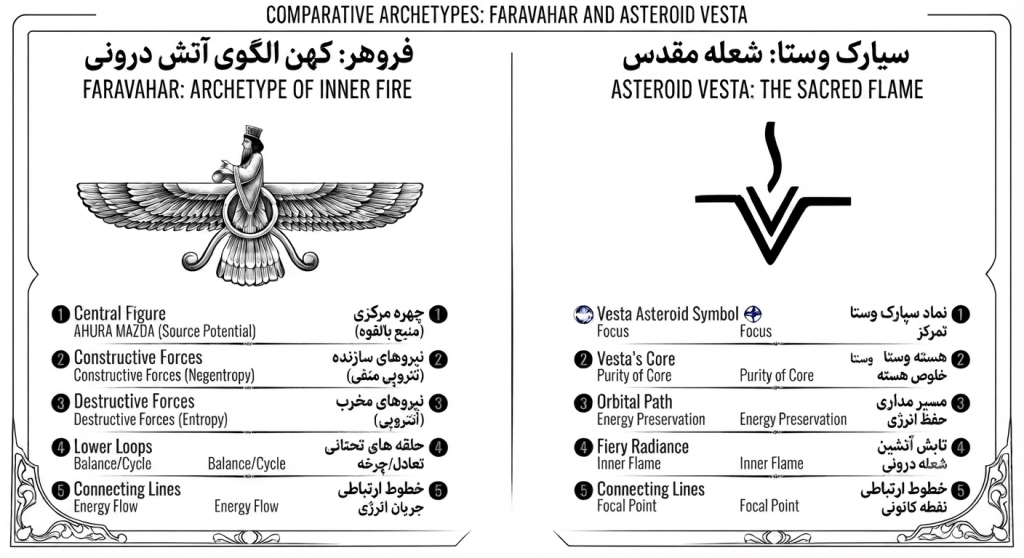
For millennia, the Faravahar has been viewed through the distorted lens of religious dogma, re-categorized as a static idol by the cultures that inherited its profound scientific legacy. This report strips away those layers to reveal the Faravahar’s true nature: a precise, geometric schematic of human willpower and thermodynamic energy management. By aligning this symbol with the astrological archetype of Vesta, we reconnect the observer to the “Fire Science” of the Proto-Elamites and Sumerians—a tradition that functioned not as a religion, but as a technical discipline for individual sovereignty. Within this framework, we distinguish between the primary planets—the Sun, Moon, and the five wandering planets—which act as the “Managers” or “Lords” of the grand design, and the asteroids—Vesta, Ceres, Juno, and Pallas—which function as the “Implementers” or actuators of physical reality. This distinction mirrors the ancient division between high-level celestial laws and the mechanics of human manifestation.
Summary: The Faravahar is an ancient, observational technology of the self, obscured by centuries of historical misinterpretation; it is a blueprint for individual thermodynamic mastery.
The Vesta-Avesta Frequency: An Observational Bridge
The term “Zend-Avesta” serves as a primary example of how technical knowledge is obscured by historical misunderstanding. In academic circles, this is widely recognized as an 18th-century misnomer, resulting from European scholars misinterpreting the physical structure of priestly study manuscripts. In these manuscripts, the Avesta (the original text) and the Zand (the explanatory commentary) were bound together as Avistāk va Zand—literally “Avesta and Zand.” Western researchers mistakenly assumed this was the formal title of the work, and over time, the label “Zend-Avesta” became the accepted, albeit inaccurate, nomenclature. To restore the operational utility of this system, we must strip away these labels and return to the underlying functional definitions. Within our engineering framework, the Avesta represents the primary dataset—the codified observations of planetary geometry and frequency. The Zand represents the kinetic protocol—the “knowledge-in-action” or technical commentary required to translate that data into human output. This linguistic convergence is not accidental when viewed alongside modern astronomy. The phonetic and conceptual link between the asteroid Vesta and the Avesta serves as a vital bridge between ancient Iranian “Fire Science” and the mechanical reality of our solar system. When astronomer Carl Friedrich Gauss discovered Vesta in 1807 and designed its glyph, he unknowingly replicated the ancient Achaemenid visual schematic: an altar supporting a sacred flame. This alignment between the Vesta-frequency in our celestial records and the Avestan tradition confirms that the ancients were not documenting mythology, but a high-fidelity observational manual for the mastery of the internal forge. By correcting the label to the Vesta-Avesta Frequency, we move from religious obfuscation toward a clear, technical understanding of how the hearth of the individual operator is tuned to the fundamental energy states of the natural world.
Summary: By correcting the label to the Vesta-Avesta Frequency, we resolve historical confusion and link the ancient Avestan kinetic protocols to the specific celestial frequency of the asteroid Vesta, confirming its role as a manual for the internal forge.
The Technical Context: Thermodynamic Aspect Cycles
To operate this schematic, we must define the energy states that were historically distorted into religious deities. These are not moral entities, but components of a thermodynamic circuit mapped to the three phases of any planetary aspect (Conjunction 0°, three hard angles 180°/90°/45°, and three soft angles 120°/60°/30°).
This cycle is the engine of human consciousness:
• Applying Aspect (First Law of Thermodynamics – Ohrmazd): As the angle approaches the exact geometric point, potential energy is gathered and compressed. This is the “good thought” phase, where the technician organizes energy for the incoming alignment.
• Exact Aspect (Ahuramazda – Source Voltage): The moment of peak geometric alignment. This is the “good deed” point, where the source potential is perfectly coupled with reality, facilitating the immediate transition from potential to kinetic energy.
• Separating Aspect (Second Law of Thermodynamics – Ahriman): After the exact point, the energy enters the phase of entropy. This is the “good word” and manifestation phase, where the concentrated energy disperses to fix the result into the material environment, managing the friction of reality.
Summary: The planetary aspect cycle functions as a thermodynamic engine, where the approach, exact alignment, and separation of planetary angles mirror the conversion of potential energy into material manifestation.
The Implementation Layer: The Astrological Actuators
As established, the foundational reasoning of the Ahuramazdan system is the commitment to a rigorous tripartite deductive process: the mental state of “Good Thought,” the articulation of “Good Words,” and the final manifestation of “Good Deeds.” Just as a modern engineer relies on physics to determine if an architectural design can stand in the material world, the ancient practitioner relied on this cycle to determine if an idea was scientifically valid. If a manifestation holds and functions within the natural world, it is accepted as truth; if it fails, it is a divergence from the principle of order. To bridge the gap between celestial potential and earthly realization, the ancients utilized the asteroids as the primary executive actuators. While the slow-moving planets define the macro-environmental “Managers,” the asteroids function as the “Field Technicians.” Each of the four main asteroids serves as an autonomous executive governor for specific human tasks:
• Vesta (The Sacred Hearth): The core engine of individual willpower and sovereignty, the furnace where the “Good Thought” is refined. The linguistic and conceptual link between the asteroid Vesta, the Avesta, and the Zend-Avesta is a critical observational link to the technical remnants of ancient Iran. This connection is validated by the history of modern astronomy; when Carl Friedrich Gauss designed the glyph for Vesta upon its discovery in 1807, he rendered an altar with a sacred flame. This visual schematic perfectly mirrors the ancient understanding that this energy signature is the prerequisite for individual independence and the mastery of the internal forge.
• Pallas (The Strategic Architect): The master engineer of the circuit. Pallas manages the strategic construction of the deed, providing the technical precision required to convert energy into a functional structure, invention, or lasting physical output.
• Juno (The Juridical Actuator): The authority that governs the “Word” as physical law. Juno handles the contractual manifestation—the formal agreements, societal bindings, and the identification of the individuals responsible for codifying law into reality.
• Ceres (The Biological Maintainer): The actuator for the management of physical resources and living systems. Ceres regulates the cycle of growth, the handling of crops and livestock, and the sustainable flow of sustenance that allows the human machine to function within the larger ecosystem.
In this system, the “Good Deed” is a mechanical success. When these executive actuators form precise geometric angles with the Managers, the “work window” for human manifestation opens. The technician monitors these specific asteroid positions to know exactly when to forge, when to contract, and when to execute. This transforms the astrological chart from a passive map into an active engineering schedule, providing the technical signal for when the potential of the Universe is ready to be harnessed by the hands of the human operator.
Summary: The executive actuators (Vesta, Pallas, Juno, and Ceres) act as independent governors for willpower, strategy, law, and resources, allowing the operator to schedule manifestations according to precise celestial geometry.
The Seven Ameshasepanta: Parameters of Chemistry, Metallurgy, and Life
The seven Ameshasepanta represent the “old chemistry” of nature and the forge. They are organized by the four elements (Fire, Earth, Air, Water) and three living entities (Humans, Animals—specifically cattle and livestock—and Plants). They function as the metallurgical and biological blueprint:
• Ahuramazda: The Prime Potential; the source voltage.
• Vohu Manah: The ignition and catalysis parameter; the threshold temperature for chemical reduction.
• Asha Vahishta: The thermal equilibrium parameter; the stoichiometric balance of fuels and airflow.
• Kshathra Vairya: The material transformation parameter; the physical output stage of refined metal and biological growth.
• Spenta Armaiti: The containment parameter; the refractory lining of the furnace and the structural integrity of the ecosystem.
• Haurvatat: The quenching parameter; the rapid cooling stage for molecular hardness and biological stability.
• Ameretat: The tempering parameter; the final stage of thermal cycling for durability and long-term resilience.
Summary: The Ameshasepanta constitute a metallurgical and biological process manual, defining the precise thermodynamic parameters required to manage chemical reduction, molecular hardness, and long-term resilience.
The Integrity of Oral Transmission
Critics often ask why this “science” left no technical manual on clay tablets. The answer lies in the nature of the knowledge itself: it was an engineering guild secret. The ancients understood that the geometry of the “Sacred Flame”—which we now measure via the Vesta-frequency—was the master-key to human independence. It was transmitted exclusively “chest-to-chest” to prevent weaponization or corruption.
Summary: The lack of written manuals is a deliberate security protocol, as the knowledge of the Vesta-frequency was deemed too high-stakes for public dissemination, requiring transmission through embodied, kinetic ritual.
3500 BCE: The Proto-Elamite and Sumerian Forge
In the cradle of Sumer and Elam, the “winged sun-disk” emerged as a technical blueprint for the mastery of the forge. Using abundant local fuels like natural gas, bitumen, and asphalt, Sumerian metallurgists harnessed intense heat to smelt and alloy copper and tin, transforming raw ores into the blades, axes, and tools that catalyzed civilization itself. This was the empirical discovery that fire—the “sacred hearth”—is the primary tool for human independence.
Summary: The development of the first thermodynamic reactors—the furnaces of the early forge—provided the empirical foundation for the ancient belief that fire is the primary tool for human independence.
2500 BCE: The Iranian Plateau Tripartite
Ancient Iranians codified this “Fire Science” into a tripartite system, mapping the internal human spark against the external forces of creation and entropy. This knowledge was transmitted through the “chest-to-chest” method—a series of vibrational, kinetic rituals and dances performed around the hearth to ensure the technology of self-mastery was physically embodied as a living, breathing lineage.
Summary: Kinetic rituals served as a method for physicalizing the technical schematic, ensuring the lineage of self-mastery was preserved through the embodiment of thermodynamic principles.
1500 BCE: The Vedic Transmission
As the fire-science migrated toward the Indus region, it was adapted into the concept of Agni—the vital mediator between human intent and cosmic law. The symbol of the flame remained a functional diagnostic tool for the Hotri, the priest-technician, who utilized this tripartite circuit to maintain the harmony of the human energetic state within the larger universal machine.
Summary: The concept of Agni confirms that fire-management was the universal scientific language of the ancient world, used by technician-priests to diagnose and maintain the energetic harmony of the human machine.
550 BCE: The Achaemenid Codification
The Achaemenid Empire officially institutionalized this geometric shorthand, adopting the name “Faravahar” at imperial sites like Persepolis. By inscribing this schematic into their architecture, they sought to anchor the oral tradition of self-mastery into the stone foundations of their engineering, preserving the science as a cornerstone of imperial order and individual sovereignty.
Summary: The Achaemenid codification was the final attempt to standardize the oral engineering manual, utilizing imperial scale to preserve the science of self-mastery.
The Climatic Catastrophe and the Rise of Abrahamic Obfuscation
Throughout these centuries, our scientific ancestors operated a functional, measurable reality. However, they were locked in a constant political struggle against “doomsayers”—proponents of Abrahamic fiction—who viewed the world through dogmatic rather than observational lenses. When planetary cycles shifted and catastrophic climatic change struck the Iranian plateau and the Near East, these doomsayers seized the political upper hand. They argued that environmental hardship was a punishment for non-compliance with their belief systems. As the scientists measured the cooling and the drought, the doomsayers mobilized the desperate populace to blame the “sacred fire” and the ancient technologies of the forge. This led to the systematic destruction of the world’s most advanced repositories of knowledge: the libraries of Alexandria, the great archives of Rome, and the foundational wisdom centers of ancient Sumer and Iran.
Summary: Environmental collapse provided the political opening for dogmatic figures to replace observable science with a system of passive obedience, leading to the destruction of the ancient archives.
300 CE – Present: The Erasure of Science
The destruction was staggered by these catastrophic weather events. Christianity emerged as a dominant state force around 300 CE—not during the life of the figure it is named for, but in the chaotic, post-calamity vacuum left by the burning of the libraries. Similarly, the rapid rise of Islam in the 6th and 7th centuries followed a massive climatic shift that brought severe, sustained bad weather to Iran. Salman al-Farisi and other figures of that era utilized the remnants of knowledge—having been exposed to the Nestorian Christians who had retrieved stolen fragments from Europe and Egypt—to reorganize society under a new religious framework. These Abrahamic structures did not preserve the science; they cannibalized it, wrapping the terminology of the Ameshasepanta and the thermodynamic forge into a restrictive, binary moral fiction.
Summary: Modern religious institutions are the structural leftovers of historical environmental collapse; they repurposed the terminology of the forge into a restrictive moral dogma that obscured our true scientific heritage.
فاراوهار به مثابه یک شماتیک مهندسی
چکیده
این گزارش، فاراوهار (Faravahar) را نه به عنوان یک سازه الهیاتی، بلکه به عنوان یک شماتیک بنیادی در مهندسی و مدیریت انرژی ترمودینامیک بازتعریف میکند. با کنار زدن لایههای تفسیرهای مذهبیِ قرون گذشته، ما این نماد را به عنوان یک نقشه فنی – یک “علم آتش” (Fire Science) – شناسایی میکنیم که توسط تمدنهای اولیه برای ترسیم اراده انسانی و حاکمیت فردی از طریق قوانین ترمودینامیک استفاده میشد. با همراستا کردن این شماتیک با کهنالگوی سیارهای “وستا” (Vesta)، نشان میدهیم که چگونه مشاهدهگران باستانی از کالیبراسیون دقیق هندسی برای تنظیم وضعیتهای انرژی درونی و بیرونی بهره میبردند. این سند به بررسی خاستگاه، انتقال و ابهامسازی نظاممند این فناوریِ مبتنی بر مشاهده میپردازد و تاریخ فلات ایران را به عنوان جایگاه اصلی توسعه سنجش نظاممند و تسلط بر خودِ انسانی، چارچوببندی میکند.
فهرست مطالب
مقدمه: مهدِ مشاهده نظاممند
احیای فاراوهار
فرکانس وستا-اوستا: یک پل مشاهدهگر
زمینه فنی: چرخههای ترمودینامیکی
لایه اجرایی: عملگرهای اخترشناختی
هفت امشاسپند: پارامترهای شیمی، متالورژی و حیات
اصالت انتقال سینه به سینه
۳۵۰۰ پیش از میلاد: کوره پروتو-ایلامی و سومری
۲۵۰۰ پیش از میلاد: نظام سهگانه فلات ایران
۱۵۰۰ پیش از میلاد: انتقال ودایی
۵۵۰ پیش از میلاد: تدوین هخامنشی
فاجعه اقلیمی و ظهور ابهامسازی ابراهیمی
۳۰۰ میلادی تا کنون: پاکسازی علم
مقدمه: مهدِ مشاهده نظاممند
مدتها پیش از ظهور علم صنعتی مدرن، تمدنهای خاور نزدیک باستان—با تمرکز بر فلات ایران و دشتهای بینالنهرین—روشهای پیچیدهای را برای اندازهگیری جهان طبیعی توسعه دادند. این فرهنگها صرفاً مشاهدهگر محیط خود نبودند؛ آنها مهندسان اولیهای بودند که دریافتند چرخههای سیارهای و گرمای زمینی، دارای نظمی هندسی و قابل اندازهگیری هستند. در قلب این رشته، یک فلسفه استدلالی بنیادی نهفته بود: ظرفیت انسانی برای وجود داشتن، یک عملِ مداوم و آگاهانه از انتخاب است. همانطور که یک باتری از طریق تعامل قطبهای مثبت و منفی انرژی تولید میکند، سیستم انسانی نیز از طریق پیمایش میان قانون اول ترمودینامیک—اهورامزدا، اصل نظم—و قانون دوم ترمودینامیک—اهریمن، اصل آنتروپی—قدرت تولید میکند. برای دستیابی به تحلیلی واقعبینانه که خطا را حذف و تغییر را میپذیرد، مشاهدهگر باستانی یک فرایند استنتاجیِ سهگانه و دقیق را دنبال میکرد: نخست، وضعیت ذهنی برای دستیابی به اندیشه نیک؛ دوم، وضعیت زبانی برای بیان گفتار نیک؛ و در نهایت، تجلیِ کردار نیک. تنها زمانی که این چرخه تکمیل شود، نتیجه به عنوان یک دستاورد واقعبینانه و علمی معتبر شناخته میشود. این سند یکی از عمیقترین یادگارهای فناوری آن دوران را بررسی میکند: فاراوهار. اگرچه فاراوهار در طول تاریخ به قلمرو اسطورهشناسی رانده شده است، اما به عنوان یک مطالعه موردی اساسی عمل میکند تا نشان دهد چگونه بشریت باستان برای نخستین بار این قوانین انرژی، اراده و دگرگونی فیزیکی را در یک سیستم مشاهدهگرِ دقیق کدگذاری کرد.
خلاصه: فرهنگهای باستانی ایران و بینالنهرین، یک «علم آتش» پیچیده توسعه دادند که اراده انسانی را به عنوان یک فرایند ترمودینامیکی قابل اندازهگیری در نظر میگرفت و از فاراوهار به عنوان نقشه اصلی این مهندسی استفاده میکرد.
احیای فاراوهار
برای هزاران سال، فاراوهار از دریچه کدرِ جزماندیشی مذهبی مشاهده شده و توسط فرهنگهایی که میراث علمی عمیق آن را به ارث بردهاند، به عنوان یک بت ایستا بازتعریف شده است. این گزارش تمام آن لایهها را کنار میزند تا ماهیت حقیقی فاراوهار را آشکار سازد: یک شماتیک دقیق و هندسی از اراده انسانی و مدیریت انرژی ترمودینامیک. با همراستا کردن این نماد با کهنالگوی اخترشناختی “وستا” (Vesta)، ما مشاهدهگر را دوباره به “علم آتش”ِ پروتو-ایلامیها و سومریان متصل میکنیم—سنتی که نه به عنوان یک دین، بلکه به عنوان یک رشته فنی برای حاکمیت فردی عمل میکرد. در این چارچوب، ما بین سیارات اصلی—خورشید، ماه و پنج سیاره سرگردان—که به عنوان “مدیران” یا “اربابان” طرح بزرگ عمل میکنند، و سیارکها—وستا، سرس، جونو و پالاس—که به عنوان “مجریان” یا عملگرهای واقعیت فیزیکی عمل میکنند، تمایز قائل میشویم. این تمایز، بازتابی از تقسیمبندی باستانی بین قوانین عالی سماوی و مکانیکِ تجلیِ انسانی است.
خلاصه: فاراوهار یک فناوری باستانی و مشاهدهگر از “خود” است که توسط قرنها تفسیر نادرست تاریخی پنهان شده بود؛ این نماد نقشهای برای تسلط ترمودینامیکی فردی است.
فرکانس وستا-اوستا: یک پل مشاهدهگر
اصطلاح “زند-اوستا” نمونه اصلیِ این است که چگونه دانش فنی با سوءتفاهمهای تاریخی مبهم میشود. در محافل آکادمیک، این اصطلاح به عنوان یک خطای قرن هجدهمی شناخته میشود که ناشی از تفسیر نادرستِ پژوهشگران اروپایی از ساختار فیزیکی نسخههای خطی کاهنان بود. در این نسخهها، “اوستا” (متن اصلی) و “زند” (تفسیر توضیحی) با هم به عنوان “اوستاک و زند” صحافی میشدند. پژوهشگران غربی به اشتباه تصور کردند که این عنوان رسمی اثر است و به مرور زمان، برچسب “زند-اوستا” به عنوان نامگذاری پذیرفتهشده—هرچند نادرست—درآمد.
برای احیای کارکرد عملیاتی این سیستم، باید این برچسبها را کنار بگذاریم و به تعاریف عملکردیِ زیربنایی بازگردیم. در چارچوب مهندسی ما، “اوستا” نشاندهنده مجموعه دادههای اولیه است—مشاهدات کدگذاریشده از هندسه و فرکانس سیارهای. “زند” نشاندهنده پروتکل جنبشی است—”دانش در عمل” یا تفسیر فنی مورد نیاز برای تبدیل آن دادهها به خروجی انسانی.
این همگرایی زبانی وقتی در کنار اخترشناسی مدرن مشاهده میشود، تصادفی نیست. پیوند آوایی و مفهومی بین سیارک “وستا” و “اوستا”، پلی حیاتی بین “علم آتش” ایرانیان باستان و واقعیت مکانیکی منظومه شمسی ما ایجاد میکند. هنگامی که کارل فردریش گاوس در سال ۱۸۰۷ سیارک وستا را کشف کرد و گلیف آن را طراحی نمود، ناخودآگاه شماتیک بصری هخامنشی را بازسازی کرد: محرابی که شعلهای مقدس را نگه داشته است. این همراستایی بین فرکانس وستا در سوابق سماوی ما و سنت اوستایی، تأیید میکند که باستانیان در حال مستندسازی اسطورهشناسی نبودند، بلکه یک راهنمای مشاهدهگر با وفاداری بالا برای تسلط بر “کوره درونی” در دست داشتند. با تصحیح برچسب به “فرکانس وستا-اوستا”، ما از ابهامسازی مذهبی به سوی درک فنیِ شفافی حرکت میکنیم که نشان میدهد چگونه کانونِ عملگرِ فردی با وضعیتهای انرژی بنیادین جهان طبیعی هماهنگ میشود.
خلاصه: با تصحیح نام به فرکانس وستا-اوستا، ما سردرگمی تاریخی را برطرف کرده و پروتکلهای جنبشیِ سنت اوستایی را به فرکانس سماویِ خاص سیارک وستا متصل میکنیم و نقش آن را به عنوان راهنمای کوره درونی تأیید مینماییم.
زمینه فنی: چرخههای ترمودینامیکی
برای بهرهبرداری از این شماتیک، باید وضعیتهای انرژی را که در طول تاریخ به خدایان مذهبی تحریف شدهاند، تعریف کنیم. اینها موجودات اخلاقی نیستند، بلکه اجزای یک مدار ترمودینامیکی هستند که با سه فازِ هر جنبه سیارهای (مقارنه ۰ درجه، سه زاویه سخت ۱۸۰/۹۰/۴۵ درجه، و سه زاویه نرم ۱۲۰/۶۰/۳۰ درجه) نگاشت شدهاند.
این چرخه، موتور آگاهی انسانی است:
• جنبه تقربی (قانون اول ترمودینامیک – اهورامزدا): همانطور که زاویه به نقطه هندسی دقیق نزدیک میشود، انرژی پتانسیل جمع و فشرده میگردد. این فازِ “اندیشه نیک” است، جایی که تکنیسین انرژی را برای همراستاییِ پیشِ رو سازماندهی میکند.
• جنبه دقیق (اهورامزدا – ولتاژ منبع): لحظه همراستایی هندسی اوج. این نقطه “کردار نیک” است، جایی که پتانسیل منبع بهطور کامل با واقعیت جفت شده و انتقالِ فوری از انرژی پتانسیل به جنبشی را تسهیل میکند.
• جنبه تفارقی (قانون دوم ترمودینامیک – اهریمن): پس از نقطه دقیق، انرژی وارد فاز آنتروپی میشود. این فازِ “گفتار نیک” و تجلی است، جایی که انرژی متمرکز پراکنده میشود تا نتیجه را در محیط مادی تثبیت کند و اصطکاک واقعیت را مدیریت نماید.
خلاصه: چرخه جنبه سیارهای مانند یک موتور ترمودینامیکی عمل میکند که در آن تقرب، همراستایی دقیق و تفارقِ زوایای سیارهای، بازتابی از تبدیل انرژی پتانسیل به تجلی مادی است.
لایه اجرایی: عملگرهای اخترشناختی
همانطور که گفته شد، استدلال بنیادی سیستم اهورامزدایی، تعهد به یک فرایند استنتاجیِ سهگانه و دقیق است: وضعیت ذهنی “اندیشه نیک”، بیانِ “گفتار نیک” و تجلی نهاییِ “کردار نیک”. همانطور که یک مهندس مدرن برای تعیین پایداری یک طرح معماری در دنیای مادی به فیزیک متکی است، مشاهدهگر باستانی برای تعیین علمی بودن یک ایده به این چرخه متکی بود. اگر یک تجلی در دنیای طبیعی حفظ شود و کار کند، به عنوان حقیقت پذیرفته میشود؛ اگر شکست بخورد، انحرافی از اصلِ نظم است.
برای پر کردن شکاف بین پتانسیل سماوی و تحققِ زمینی، باستانیان از سیارکها به عنوان عملگرهای اجرایی اصلی استفاده میکردند. در حالی که سیارات کندرو، “مدیران” کلانمحیطی را تعریف میکنند، سیارکها به عنوان “تکنیسینهای میدانی” عمل میکنند. هر یک از چهار سیارک اصلی به عنوان یک فرماندار اجرایی خودگردان
برای وظایف خاص انسانی عمل میکند:
• وستا (محراب مقدس): موتور اصلیِ اراده و حاکمیت فردی، کورهای که در آن “اندیشه نیک” پالایش میشود. پیوند زبانی و مفهومی بین سیارک وستا، اوستا و زند-اوستا، یک پیوند مشاهدهگرِ حیاتی به بقایای فنی ایران باستان است. این ارتباط توسط تاریخ اخترشناسی مدرن تأیید شده است؛ هنگامی که کارل فردریش گاوس گلیف وستا را پس از کشف آن در ۱۸۰۷ طراحی کرد، محرابی با شعلهای مقدس را ترسیم نمود. این شماتیک بصری بهطور کامل بازتابی از درک باستانی است که این امضای انرژی، پیششرط استقلال فردی و تسلط بر کوره درونی است.
• پالاس (معمار استراتژیک): مهندس ارشدِ مدار. پالاس ساختار استراتژیکِ کردار را مدیریت میکند و دقت فنیِ لازم برای تبدیل انرژی به یک ساختار عملکردی، اختراع یا خروجی فیزیکی پایدار را فراهم میسازد.
• جونو (عملگر حقوقی): مرجعی که “گفتار” را به عنوان قانون فیزیکی حاکم میکند. جونو تجلیِ قراردادی—توافقات رسمی، الزامات اجتماعی و شناساییِ افراد مسئول برای تدوین قانون در واقعیت—را مدیریت میکند.
• سرس (نگهبان بیولوژیکی): عملگرِ مدیریت منابع فیزیکی و سیستمهای زنده. سرس چرخه رشد، رسیدگی به محصولات و دامها و جریان پایدارِ معیشتی که اجازه میدهد ماشینِ انسانی در اکوسیستم بزرگتر عمل کند را تنظیم مینماید.
در این سیستم، “کردار نیک” یک موفقیت مکانیکی است. هنگامی که این عملگرهای اجرایی، زوایای هندسی دقیقی با مدیران تشکیل میدهند، “پنجره کاری” برای تجلیِ انسانی باز میشود. تکنیسین، وضعیتهای خاص این سیارکها را زیر نظر میگیرد تا بداند دقیقاً چه زمانی برای ساختن، چه زمانی برای قرارداد بستن و چه زمانی برای اجرا اقدام کند. این کار، نمودار اخترشناختی را از یک نقشه منفعل به یک برنامه مهندسی فعال تبدیل میکند و سیگنال فنی را برای زمانی که پتانسیل جهان آماده است تا توسط دستانِ عملگرِ انسانی مهار شود، فراهم میسازد.
خلاصه: عملگرهای اجرایی (وستا، پالاس، جونو و سرس) به عنوان فرمانداران مستقل برای اراده، استراتژی، قانون و منابع عمل میکنند و به عملگر اجازه میدهند تا تجلیات خود را بر اساس هندسه دقیق سماوی زمانبندی کند.
هفت امشاسپند: پارامترهای شیمی، متالورژی و حیات
هفت امشاسپند نشاندهنده “شیمی کهن” طبیعت و کوره هستند. آنها توسط چهار عنصر (آتش، زمین، هوا، آب) و سه موجود زنده (انسانها، حیوانات—بهویژه گاو و دام—و گیاهان) سازماندهی شدهاند. آنها به عنوان نقشه
متالورژی و بیولوژیکی عمل میکنند:
• اهورامزدا: پتانسیل اولیه؛ ولتاژ منبع.
• وهومن: پارامتر جرقه و کاتالیز؛ دمای آستانه برای احیای شیمیایی.
• اردیبهشت: پارامتر تعادل حرارتی؛ تعادل استوکیومتریِ سوختها و جریان هوا.
• شهریور: پارامتر دگرگونی مادی؛ مرحله خروجی فیزیکیِ فلزِ پالایششده و رشد بیولوژیکی.
• سپندارمذ: پارامتر مهار؛ پوشش نسوزِ کوره و یکپارچگی ساختاریِ اکوسیستم.
• خرداد: پارامتر خنکسازی سریع؛ مرحله کاهش دما برای سختیِ مولکولی و پایداری بیولوژیکی.
• امرداد: پارامتر تمپرینگ (سختکاری)؛ مرحله نهایی چرخههای حرارتی برای دوام و تابآوریِ بلندمدت.
خلاصه: امشاسپندان یک راهنمای فرایند متالورژی و بیولوژیکی را تشکیل میدهند که پارامترهای دقیق ترمودینامیکی مورد نیاز برای مدیریت احیای شیمیایی، سختی مولکولی و تابآوری بلندمدت را تعریف میکند.
اصالت انتقال سینه به سینه
منتقدان اغلب میپرسند که چرا این “علم” هیچ دفترچه راهنمای فنیای روی لوحهای گلی باقی نگذاشته است. پاسخ در ماهیتِ خودِ دانش نهفته است: این یک رازِ صنفیِ مهندسی بود. باستانیان درک میکردند که هندسه “شعله مقدس”—که ما اکنون آن را از طریق فرکانس وستا اندازهگیری میکنیم—کلیدِ اصلیِ استقلال انسانی است. این دانش منحصراً “سینه به سینه” منتقل میشد تا از استفاده ابزاری یا فساد جلوگیری شود.
خلاصه: نبودِ راهنماهای مکتوب، یک پروتکل امنیتیِ عامدانه است، زیرا دانشِ فرکانس وستا برای انتشار عمومی بیش از حد حساس تلقی میشد و نیازمند انتقال از طریقِ آیینهای جنبشی و تجسمیافته بود.
۳۵۰۰ پیش از میلاد: کوره پروتو-ایلامی و سومری
در مهدِ سومر و ایلام، “قرص خورشید بالدار” به عنوان یک نقشه فنی برای تسلط بر کوره ظهور کرد. متالورژیستهای سومری با استفاده از سوختهای محلیِ فراوان مانند گاز طبیعی، بیتومن و آسفالت، گرمای شدیدی را برای ذوب و آلیاژسازی مس و قلع مهار کردند و سنگهای معدنیِ خام را به تیغهها، تبرها و ابزارهایی تبدیل کردند که خودِ تمدن را کاتالیز میکرد. این اکتشاف تجربی بود که آتش—”محراب مقدس”—ابزار اصلی برای استقلال انسانی است.
خلاصه: توسعه اولین رآکتورهای ترمودینامیکی—کورههای کوره اولیه—بنیاد تجربی برای باور باستانی فراهم کرد که آتش، ابزار اصلی برای استقلال انسانی است.
۲۵۰۰ پیش از میلاد: نظام سهگانه فلات ایران
ایرانیان باستان این “علم آتش” را به یک سیستم سهگانه کدگذاری کردند و جرقه درونی انسان را در برابر نیروهای بیرونیِ آفرینش و آنتروپی ترسیم نمودند. این دانش از طریق روش “سینه به سینه” منتقل میشد—مجموعهای از آیینها و رقصهای جنبشی و ارتعاشی که در اطرافِ محراب انجام میشد تا اطمینان حاصل شود که فناوریِ تسلط بر خود، بهطور فیزیکی به عنوان یک دودمانِ زنده و پویا تجسم یافته است.
خلاصه: آیینهای جنبشی به عنوان روشی برای فیزیکیسازیِ شماتیکِ فنی عمل میکردند و اطمینان میدادند که دودمانِ تسلط بر خود از طریق تجسمِ اصول ترمودینامیکی حفظ میشود.
۱۵۰۰ پیش از میلاد: انتقال ودایی
هنگامی که علم آتش به سمت منطقه سند مهاجرت کرد، با مفهوم “آگنی”—واسطه حیاتی بین اراده انسانی و قانون کیهانی—سازگار شد. نمادِ شعله به عنوان یک ابزار تشخیصیِ عملکردی برای “هوتری” (priest-technician) باقی ماند که از این مدارِ سهگانه برای حفظ هماهنگیِ وضعیت انرژیِ انسانی در ماشینِ بزرگِ جهانی استفاده میکرد.
خلاصه: مفهوم آگنی تأیید میکند که مدیریتِ آتش، زبان علمیِ جهانیِ دنیای باستان بود که توسط کاهن-تکنیسینها برای تشخیص و حفظ هماهنگیِ انرژیِ ماشینِ انسانی استفاده میشد.
۵۵۰ پیش از میلاد: تدوین هخامنشی
امپراتوری هخامنشی بهطور رسمی این خطِمشیِ هندسی را نهادینه کرد و نام “فاراوهار” را در مکانهای امپراتوری مانند تختجمشید برگزید. آنها با حک کردن این شماتیک در معماری خود، سعی کردند سنتِ شفاهیِ تسلط بر خود را در پیریزیهای سنگیِ مهندسیِ خود لنگر بیندازند و علم را به عنوان سنگبنای نظمِ امپراتوری و حاکمیت فردی حفظ کنند.
خلاصه: تدوین هخامنشی، آخرین تلاش برای استانداردسازیِ راهنمای مهندسیِ شفاهی بود که با استفاده از مقیاسِ امپراتوری برای حفظ علمِ تسلط بر خود انجام شد.
فاجعه اقلیمی و ظهور ابهامسازی ابراهیمی
در طول این قرنها، نیاکان علمی ما با یک واقعیتِ عملکردی و قابل اندازهگیری کار میکردند. با این حال، آنها در یک مبارزه سیاسیِ دائمی علیه “رستاخیزگرایان”—مبلغانِ داستانهای ابراهیمی—قرار داشتند که جهان را نه از دریچه مشاهده، بلکه از دریچه جزماندیشی میدیدند. هنگامی که چرخههای سیارهای تغییر کردند و تغییرات اقلیمیِ فاجعهبار به فلات ایران و خاور نزدیک ضربه زد، این رستاخیزگرایان دستِ بالا را در سیاست به دست گرفتند. آنها استدلال میکردند که سختیهای محیطی، مجازاتی برای عدم انطباق با سیستمهای اعتقادیِ آنهاست. همانطور که دانشمندان سرد شدن و خشکسالی را اندازهگیری میکردند، رستاخیزگرایان مردمِ ناامید را تحریک کردند تا “آتش مقدس” و فناوریهای کهنِ کوره را مقصر بدانند. این امر منجر به تخریب نظاممندِ پیشرفتهترین مخازن دانش جهان شد: کتابخانههای اسکندریه، آرشیوهای بزرگ رم و مراکز حکمتِ بنیادی در سومر و ایران باستان.
خلاصه: فروپاشی محیط زیستی، فضای سیاسی را برای چهرههای جزماندیش فراهم کرد تا علمِ قابل مشاهده را با سیستمی از اطاعتِ منفعلانه جایگزین کنند که به تخریب آرشیوهای باستانی منجر شد.
۳۰۰ میلادی تا کنون: پاکسازی علم
این تخریبها توسط این رویدادهای جویِ فاجعهبار بهطور متناوب صورت گرفت. مسیحیت حدود سال ۳۰۰ میلادی به عنوان یک نیروی غالبِ دولتی ظهور کرد—نه در طولِ زندگیِ شخصیتی که نامش را بر آن گذاشتهاند، بلکه در خلأِ پرآشوبِ پس از فاجعه که ناشی از سوزاندنِ کتابخانهها بود. به همین ترتیب، ظهور سریع اسلام در قرن ششم و هفتم میلادی، پس از یک تغییر اقلیمی عظیم رخ داد که آبوهوای سخت و پایداری را برای ایران به ارمغان آورد. سلمان فارسی و دیگر چهرههای آن دوران از بقایای دانش—که پس از مواجهه با مسیحیانِ نسطوری که قطعاتِ ربودهشده از اروپا و مصر را بازیابی کرده بودند—استفاده کردند تا جامعه را تحت یک چارچوبِ مذهبیِ جدید سازماندهی کنند. این ساختارهای ابراهیمی، علم را حفظ نکردند؛ بلکه آن را مصادره کردند و اصطلاحاتِ امشاسپندان و کوره ترمودینامیکی را در یک داستانِ اخلاقیِ دوتایی و محدودکننده پیچیدند.
خلاصه: نهادهای مذهبیِ مدرن، بازماندههای ساختاریِ فروپاشیِ اقلیمیِ تاریخی هستند؛ آنها اصطلاحاتِ کوره را به یک جزمِ اخلاقیِ محدودکننده تبدیل کردند که میراثِ علمیِ حقیقیِ ما را پنهان کرد.
I asked Gemini and NotebookLM
فارسی اشتباهات دارد

